We use the special going to construction when we have the intention to do something before we speak. We have already made a decision before speaking. Look at these examples:
I have won $1,000. I am going to buy a new TV.
We’re not going to see my mother tomorrow.
When are you going to go on holiday?
In these examples, we had an intention or plan before speaking. The decision was made before we spoke.
Prediction
We often use going to to make a prediction about the future. Our prediction is based on evidence. We are saying what seems sure to happen. Here are some examples:
The sky is very black. It is going to snow.
It’s 8.30! You’re going to miss the train!
I crashed the company car. My boss isn’t going to be very happy!
In these examples, the present situation (black sky/the time/damaged car) gives us a good idea of what is going to happen. Try some games to practise “be going to+inf” to express future plans or predictions. I’m sure you ARE GOING TO like them! (From www.englishclub.com
Airport are special places where you can see all sort of stories unfold: family reunions, business travellers, students on a study trip, holiday makers, couples on their honeymoon, emigrants looking for a new chance in life, lovers reunited etc… There was even a film ” The Terminal” based on the story of a passenger who got stranded in an airport and ended up living there! On the 27th of October a mobile phone company filmed their new ad in Terminal 5, Heathrow airport( London), one of the busiest airports in the world. Passengers arriving were assaulted by singers, the result is a great video. Check it out It is fantastic, isn´t it? Have you got an airport story to share?
When we describe a favourite photo we can take into account the following information: 1) Who took it? 2) What was happening when you took the photo? 3) Why do you like it? 4) Where do you keep it? Here’s an example which describes the picture above: “One of my favourite photos is this one of my husband James and my son Peter. I took it last summer in Menorca (Spain), when we were on holiday. We were at a place called “Cala Mitjana”. It’s a beach which is famous for its blue water and its peace. When I took the picture, my husband and my son were playing together. I was sunbathing when I decided to take a nice picture of both. I love this photo because it represents happiness for me. It reminds me of a lovely holiday with my family. I keep the photo in a family album and I also have it on the living-room table.” Would you like to practise a bit more? Here you can find a lesson to learn to describe photos.
The past continuous is formed from the past tense of the verb to be with the -ing form of the verb. We use it to talk about continuous actions in the past. Look at the British Council website for a detailed explanation and exercises. Here are some activities to practise: exercisescity life activityyesterday at the beach story The past continuous vs.the past simple We use the past simple to talk about completed actions in the past and the past continuous to describe continuous actions and ‘background actions’. Activities: exercise 1exercise 2exercise 3 Sing along to this beautiful song by Robbie Williams, Eternity, and look out of the examples of the past forms.
Every language has irregular verbs and English is no exception ! Unfortunately there is no magic formula, you simply have to learn them by heart! Here is a list. Try to learn the most useful ones first and then learn the others little by little. Here is a game for you to practise and a crossword . Some more activities: regular or irregular verbs? interactive exercise 1 interactive exercise 2
Finally a fantastic song by the Beatles
When you form the regular past tense in English you need to pay attention to two things: pronunciation and spelling. PRONUNCIATION To form the simple past you simply add -edto the end of the infinitive and you have the simple past. -edcan be pronounced in three different ways: /t/, /d/ and /id/. “T”is a voiceless consonant what we called “sorda” in Spanish that means you will feel no vibration in your throat, just a short explosion of air as you pronounce. These are some voiceless consonants : p, t, k, s, sh, ch, th (as in thing) “D” is a voiced consonant what we called “sonora” in Spanish that means you feel a vibration in your throat when you pronounce it. These are some voiced consonants : b, d, th (as in then), v, l, r, z, j (as in Jane) Vowels are always voiced. If a verb ends in t or d then the -ed will be pronounced as a whole new syllable /id/ So the sound of the past : -ed will assimilate the sound of the preceding sound and so if it is a voiced sound the pronunciation of -ed will be voiced /d/ and if voiceless it will go to /t/. To sum up, you have three options with the pronunciation of the regular past tense -ed: /t/, /d/ or /id/ Here you have a video to practise and some interactive exercises: Choose the right sound Try again Number 3 Nice one from the BBC SPELLING With most regular verbs, the simple past is created simply by adding -ed. However, with some verbs, you need to add -d or change the ending. Here are the rules:
Exercise1 , Try exercises with pictures, vocabulary etc. Exercise 2 , There are five exercises to practice the vocabulary of clothes,some verbs like
suit,wear,fit,match,try on... some adjectives and colours.If you think that
there is something that it could be better tell me Exercise 3
Forming questions in English can be a little complicated but if you remember this simple formula you’ll have no problem: ASI Auxiliary Subject Infinitive Do you like football? Does your sister work? or QUASI Question word Auxiliary SubjectInfinitive Where do you live? What does Peter do? You can use this formula in the past simple too. Try this game to practise and click here for another question formation activity.
We use the present simple to talk about daily routines and every day activities. Look at these examples:
We leave for work at 7:30 AM every morning.
My husband watches the TV in the evening.
Susan often meets with her friends after school.
They usually play football on Sunday.
Mark rarely visits his sick grandmother.
Try these exercises to practise the different forms: affirmative, negatives and questions For some listening practice about people’s daily routines click here and here
Listening can sometimes be one of the more difficult skills. Here is a great website which is specially for your level, called Elementary Podcasts by the British Council. There are lots of texts to listen to and you can also download the mp3 files and save them on to your computer, mobile phone or mp3 player. Special packs are available with activities to do and the tapescripts.
To speak well in English or to speak good English you need to practise as much as you can, with English tourists, going to any English speaking country and of course with your teacher, your classmates and the school’s conversation assistant Maire Larkin. By clicking here you can watch some common situations and practise your English. In this link you can practise many everyday situation and interact with a robot. Here you can have a virtual chat. Here I leave some examples of monologues on basic topics and the holidays you may help you prepare for your oral exam. I also leave you with some typical monologue questions for you to plan answers for. You can always teach your friends, watch here Pepe Reina teaching Iker Casillas some basic English.
Reading is an excellent way to develop your English vocabulary, try these easy stories and do the exercises. If you click here you will have access to exam type exercises. And here you can see two nice stories with exercises. If you want more check this out. A hundred stories about life in America with exercises. Enjoy!
There are 4 future forms in English. The one which is used most often in spoken English is ‘going to’.
We use ‘going to’ when we want to talk about a plan for the future. Example: I‘m going to see him later today.
Notice that this plan does not have to be for the near future. Example: In ten years time, I’m going to be boss of my own company.
We use ‘going to’ when we want to make a prediction based on evidence we can see now. Example: Look at those black clouds. It‘s going to rain soon.
Check these exercises: 1, 2, 3, 4, 5.
Now, think about your future. Here you are some questions to answer:
1) What are you going to do with your life?
2) What are you going to do after this class?
3) Where are you going to go for your next holiday?
4) Are you going to meet anyone at the weekend?
5) Are you going to watch television tonight? 6) What book are you going to read next?
7) When are you going to stop smoking?
8) What are you going to have for lunch / dinner?
9) Where in the world are you going to travel?
10) How are you going to get better at English?
In a city, there are a lot of different shops, check them here or try this interactive book once published (It also includes directions on pages 15-17)
GIVING DIRECTIONS
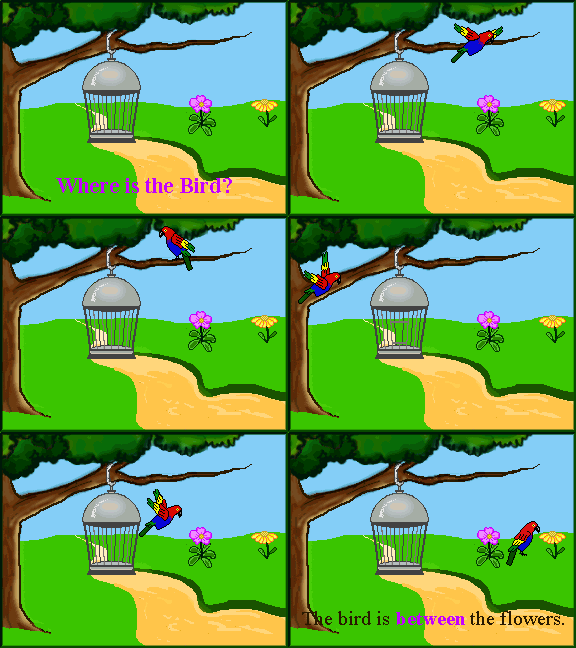
First of all, let’s revise the prepositions of place again. Check them here and do these exercises.
Sometimes, we get lost in a new city and we need to ask for directions. We typically ask Excuse me, is there a BANK around here? How can I get there?
The answer will include one or some of the expressions below. Click on the image and find the places they describe:
Where do you live? What kind of house do you have? Check and listen to the different possibilities here.
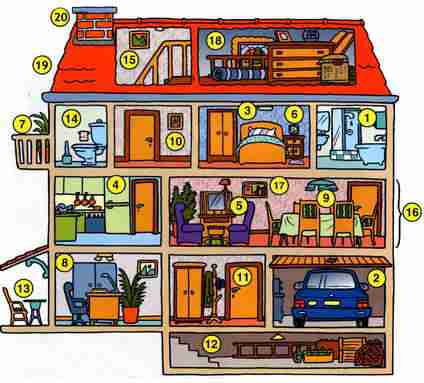
How many rooms are there in your house? Check this vocabulary and listen to the words. A very special part of your house is your bedroom. Check this vocabulary and describe your room. Finally, complete this wonderful book: How much do you remember? Look at the picture and try to name the different rooms and pieces of furniture you can see:
Find the names below in case you couldn’t remember them:
1
The bathroom
2
The garage
3
The bedroom
4
The kitchen
5
The living room
6
The alarm clock
7
The balcony
8
The office
9
The table
10
The corridor
11
The hall
12
The cellar
13
The terrace
14
The toilet
15
Stairs
16
The dining room
17
The picture
18
The attic
19
The roof
20
The chimney
If you feel you need some extra vocabulary to describe furniture in each room of the house, this vocabulary and listen to the words.
We already published a post on there is/ there are, but let’s remember how they work:
RULES:
1. Use there IS for singular countable nouns (one item) + a/an. 2. Use there IS for non-countable items + some. 3. Use there ARE for many items (plural nouns).
See information on countable and uncountable nouns here. There is a spider on the wall. There is some milk on the floor. There arepencils on my desk.
The negative and interrogative form follows verb TO BE forms. Have a look at these examples:
There is not a book. - There isn’t a book. There are not books. - There aren’t books.
For questions, remember you need an inversion.
Is there a book? Are there any books? Yes, there is. Yes, there are. No, there isn’t. No, there aren’t
You had some exercises on the previous post. Now try this exercise on there is/there are to talk about singular/plural nouns or uncountable nouns and another one to practise the negative form. And also exercises in the past! 1, 2, 3, 4, 5
There are two kinds of nouns in English, countable and uncountable.
Countable = Countable nouns are easy to recognize. They are things that we can count. For example: “pen”. We can count pens. We can have one, two, three or more pens.
Countable nouns can be singular or plural:
My dog is playing.
My dogs are hungry.
We can use the indefinite article a/an with countable nouns:
A dog is an animal.
When a countable noun is plural, we can use it alone, I like oranges, or we can use some and any, I have some dollars, Do you have any pens?
“People” is countable. “People” is the plural of “person”. We can count people: There is one person here – There are three people here.
Uncountable = Uncountable nouns are substances, concepts, etc that we cannot divide into separate elements. We cannot “count” them. For example, we cannot count “milk”. We can count “bottles of milk” or “litres of milk”, but we cannot count “milk” itself.
Drinks (coffee, water, orange juice) are usually uncountable. But if we are thinking of a cup or a glass, we can say (in a restaurant, for example):
Two teas and one coffee please.
We treat uncountable nouns as singular. We use a singular verb. For example: Your luggage looks heavy.
Uncountable nouns can’t be plural: butter, meat NOT two butters , three meats.
We use some and any with uncountable nouns:
I’ve got some money.
Have you got any rice?
REMEMBER: we use some in positive sentences and any in negative sentences + questions. Examples: I have some friends - Do you have any cheese? – He doesn’t have any friends in Chicago. Try now some exercises: 1,2, 3 We use How much …? with uncountable nouns and How many …..? with plural countable nouns. Exercises 1, 2, 3, Finally you can listen and watch the song and complete the lyrics.
As we finished the introduction of both regulars and some irregulars, you are now ready to do some exercises combining both. First of all, have a look at this interactive book:
Remember:
* We use past simple to describe past actions, for example, what did they do yesterday? Complete this exercise
*Past simple is necessary when describing someone’s life; do you like football? Here you are Ronaldo’s and Messi’s biography to complete with past simple.
* note that it is the sound that is important, not the letter or spelling. For example, “fax” ends in the letter “x” but the sound /s/; “like” ends in the letter “e” but the sound /k/.
NEVER pronounce /ed/!!! Whenever you see a word ending in –ed, visualize the “e” as crossed out, if you want to increase your chances of pronouncing it correctly!
Is it clear enough? What’s the final sound of the following verbs? Choose the right one here.
Do you need more practice? Choose the correct “ed” ending sound in these multiple choice exercises. Exercise 1 – Exercise 2 - Exercise 3 – Exercise 4 – Exercise 5- Exercise 6. Don’t worry if you don’t know the meaning of some verbs, focus on their pronunciation.
Final Exam – Practice what you have learned by choosing the correct pronunciation for multiple words written in a paragraph.
Now you are ready to practise some listening. Try this site or this one and, finally, this one combines present and past pronunciations.
We have two different groups to form the Simple Past:
You have to know all forms of the irregular verbs very well. For the Simple Past you need the form of the verb which can be found in the 2nd column of the table of the irregular verbs. Example: go – went.
90% of verbs are regular verbs so let’s start with regulars first.


 Airport are special places where you can see all sort of stories unfold: family reunions, business travellers, students on a study trip, holiday makers, couples on their honeymoon, emigrants looking for a new chance in life, lovers reunited etc…


 lived
lived